For a long time, the mirror test was treated like one of the most exclusive clubs in animal science. If an animal could recognize itself in a mirror, researchers often took that as a major sign of self-awareness. Great apes made the list. So did elephants, dolphins, and magpies in some experiments. Fish were never supposed to belong in that conversation. Then along came the cleaner wrasse, a small reef fish that has spent the last few years making scientists question everything they thought they knew about intelligence.
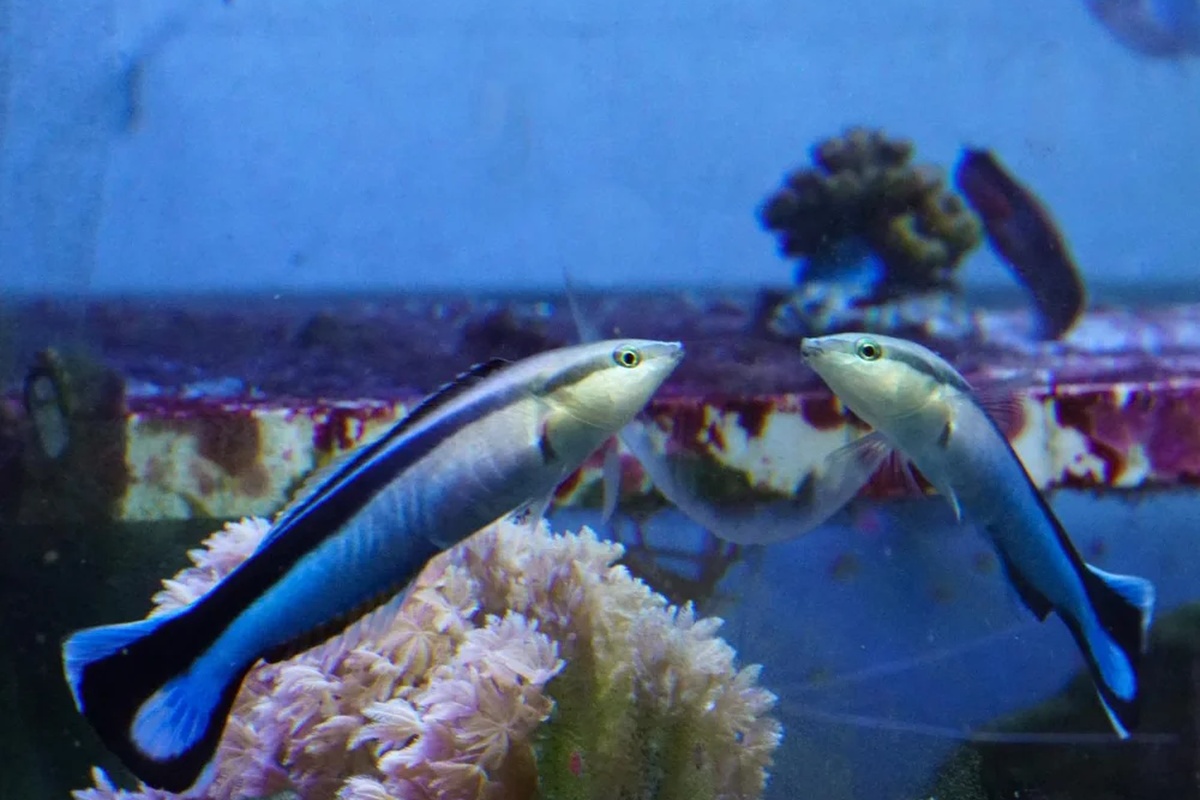
The cleaner wrasse first caused a sensation in 2018, when researchers reported that it appeared to pass the mirror test. The result was explosive, but also controversial. Many scientists were skeptical because fish brains are very different from mammal brains, and because the mirror test itself has always been debated. Critics argued that unusual behavior around mirrors does not automatically prove self-awareness. That skepticism did not kill the idea, though. Instead, it pushed researchers to redesign the experiments and ask a better question: what exactly is the fish understanding when it looks in the mirror?
That is where the newer studies became so interesting. In a 2023 PNAS paper, researchers reported that cleaner fish likely recognize their own reflected face, using something comparable to self-face recognition in humans. Rather than simply reacting to “another fish,” the animals behaved in ways suggesting they were checking whether the image matched their own body. This was a major shift from the older interpretation of the mirror test as just a yes or no trick. It suggested that fish may not merely respond to reflections, but may actually compare what they see to an internal image of themselves.
Then came another important step. A 2025 study in Scientific Reports explored whether cleaner wrasse show signs of rapid self-recognition even before the classic mirror-mark test is fully completed. The researchers argued that many animals may produce “false negatives” in standard mirror tests, meaning they could possess some form of self-recognition even if they fail the usual criteria. In cleaner fish, the behavior suggested that using a mirror as a source of information may come earlier and faster than scientists assumed. That matters because it pushes the debate beyond one rigid test and toward a broader understanding of self-awareness on a spectrum.
One of the most striking details from coverage of the newer work is how quickly the fish responded to the fake parasite mark. According to the researchers’ summary, some fish attempted parasite-removal behavior within about 82 minutes, hinting that they were not just confused or randomly reacting. They seemed to connect the visible mark with their own body and act on that information. That is exactly why the findings have grabbed attention: a fish is not supposed to do something that looks this close to self-directed inspection. Yet that is what the experiments appear to show.
Even more surprising is the suggestion that cleaner wrasse may use the mirror almost like a tool. The recent work indicates they can exploit reflected information to inspect things that would otherwise be difficult to see directly. Scientists have highlighted this as especially notable because mirror tool use has usually been associated with species considered cognitively advanced. Related brain studies on wrasses have also found that some tool-using wrasse species possess unexpectedly sophisticated neural organization, showing that fish cognition may have evolved along very different paths from birds and mammals rather than being simply “lesser.”
This is why the cleaner wrasse story has become bigger than one fish and one mirror. It touches a much deeper scientific issue: are humans underestimating animal minds because we keep measuring them by mammal standards? The 2025 Royal Society discussion of mirror self-recognition and its evolutionary origins points out that self-related cognition may be more widespread across the animal kingdom than once believed. Some scientists now argue that forms of self-awareness could have very ancient evolutionary roots, potentially stretching back hundreds of millions of years. That does not mean every animal experiences the self the way humans do. It means the building blocks of self-recognition may be older, broader, and more diverse than we assumed.
The cleaner wrasse is especially fascinating because its lifestyle may help explain why such cognitive abilities evolved. These fish survive by removing parasites from other fish, which requires detailed visual discrimination, memory, social decision-making, and reading the behavior of clients. In other words, they already live in a world where noticing fine body details matters. A brain does not have to be large like a chimpanzee’s to solve complex problems. Sometimes evolution builds intelligence differently, shaped by survival needs rather than by size alone.
Of course, the debate is not over. Some researchers still caution that passing or partially passing a mirror test should not be treated as final proof of human-like self-awareness. That warning is fair. Animal cognition is messy, and no single experiment can fully capture what another species experiences. But that is exactly what makes the cleaner fish so important. It is forcing science to ask smarter questions. Maybe intelligence is not a ladder with humans and apes at the top. Maybe it is a web, with different species evolving different ways to understand themselves and the world.
And that may be the biggest surprise of all. A tiny reef fish has not just passed an unusual test. It has helped crack open one of biology’s most stubborn assumptions. Self-awareness may not be rare, elite, or reserved for animals that look like us. It may be far older, far stranger, and far more common in nature than anyone imagined
The post Small Fish, Huge Mind: The Marine Fish That Shocked Scientists With Signs of Self-Awareness appeared first on Women Daily Magazine.
https://ift.tt/Jpj2TAd
Comments
Post a Comment