Artificial intelligence is rapidly transforming science, pushing boundaries that once seemed impossible. From medicine to climate research, AI is unlocking new solutions at an unprecedented pace. But with every breakthrough comes a new question: how far is too far?
A growing number of researchers are now using AI to design genetically modified viruses, specifically engineered to attack harmful bacteria. While this sounds like a revolutionary step in fighting antibiotic resistance, it also raises serious concerns about safety, ethics, and control.
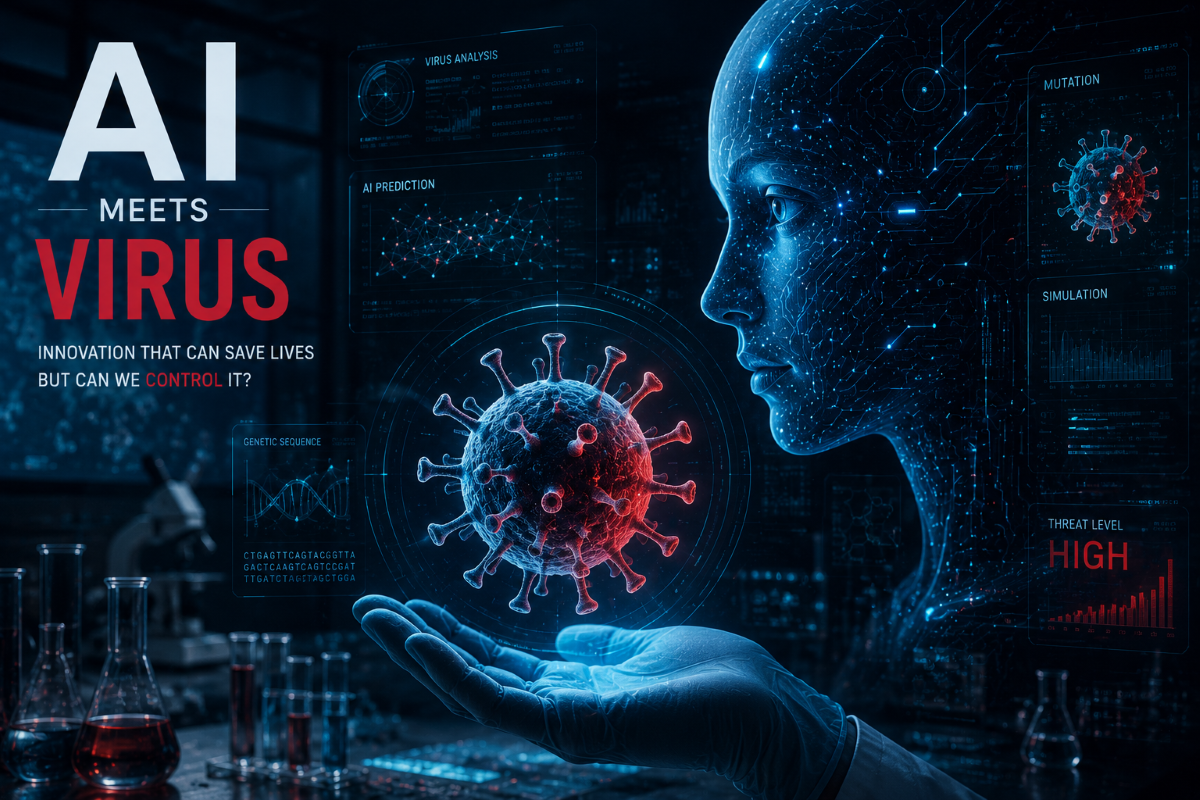
Smarter Viruses That Target Bacteria
Scientists are increasingly exploring bacteriophages, viruses that infect and destroy bacteria. With the help of AI, these viruses can now be designed with greater precision than ever before. Instead of relying on natural evolution, researchers can simulate countless variations and select the most effective ones.
This approach has the potential to solve one of the biggest challenges in modern medicine: antibiotic resistance. As bacteria become stronger and more resistant to traditional drugs, AI-designed viruses could offer a new line of defense.
Institutions like MIT and Stanford University are already exploring how machine learning can accelerate discoveries in biotechnology. The results are promising, but they also highlight how powerful these tools have become.
A Step Toward Artificial Life
Beyond fighting infections, AI is opening the door to something even more complex the creation of artificial lifeforms.
By combining genetic engineering with advanced algorithms, scientists can design biological systems from scratch. This doesn’t just mean modifying existing viruses, but potentially creating entirely new ones with specific functions.
Experts warn that this level of control over biology represents a major shift. According to researchers connected to World Health Organization, the line between innovation and risk becomes thinner as technology advances faster than regulation.
The idea of “programmable biology” may sound futuristic, but it is quickly becoming reality.
The Risks Outside the Lab
While the benefits are significant, the risks cannot be ignored.
One of the biggest concerns is what happens if these engineered viruses escape controlled environments. Even with strict lab protocols, accidents are always a possibility. A virus designed to target bacteria could mutate, behave unpredictably, or interact with ecosystems in unforeseen ways.
There is also the issue of misuse. Powerful technologies often carry dual-use risks, meaning they can be used for both beneficial and harmful purposes. In the wrong hands, AI-designed biological agents could become a serious global threat.
Organizations like United Nations have already raised concerns about the need for stronger international regulations in biotechnology and AI development.
The Ethical Dilemma
At the heart of this debate is a fundamental ethical question. Just because we can create something, does it mean we should?
Scientists, policymakers, and ethicists are now grappling with how to balance innovation with responsibility. Transparency, regulation, and global cooperation will be key in ensuring that these technologies are used safely.
There is also a growing call for public awareness. As AI becomes more deeply integrated into science, people need to understand not only its benefits, but also its potential consequences.
AI-designed viruses represent one of the most fascinating and controversial developments of our time. They could revolutionize medicine, save lives, and reshape how we fight disease.
But they also remind us of a critical truth. The more powerful our tools become, the greater our responsibility to use them wisely.
The future of biotechnology will not just depend on what we can create, but on the choices we make along the way.
The post AI and Genetically Modified Viruses: Innovation or Threat? appeared first on Women Daily Magazine.
https://ift.tt/OHWs3aY
Comments
Post a Comment