Aging has become one of the most profitable fears in the modern world. Everywhere we look, someone is promising to slow it down, reverse it, decode it or defeat it completely. Luxury clinics offer biological age tests, personalized supplement plans, plasma treatments, expensive scans and futuristic therapies that sound like they belong in a science fiction movie. Social media turns every new molecule, diet trend or celebrity routine into a potential “secret” to living forever.
But behind the glossy promise of eternal youth, there is one uncomfortable question: are we actually getting more life, or are we just spending more money because we are afraid of getting older?
The longevity industry is booming because it sells something deeply emotional. It does not only sell health. It sells control. It sells the idea that aging is a problem we can outsmart if we pay enough, track enough and optimize enough. Yet the science is much more cautious than the marketing.
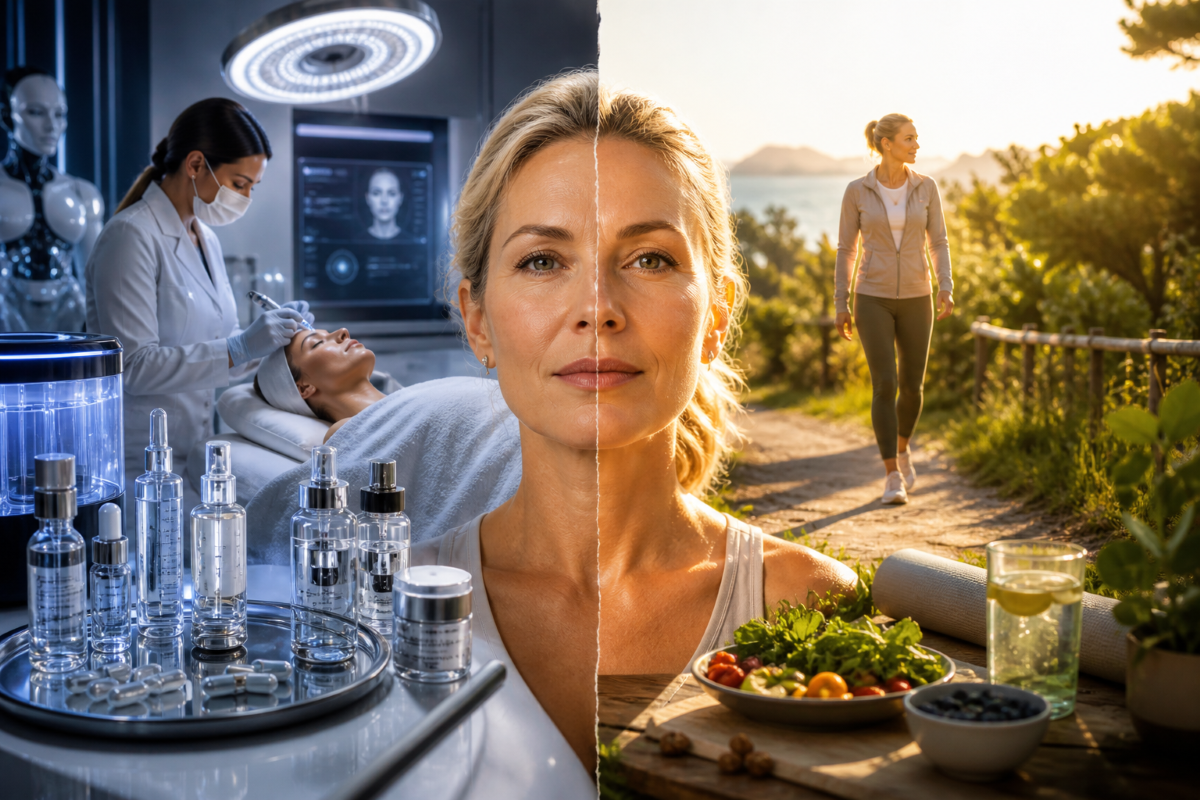
Trading on the Fear of Aging
The fear of aging is not new, but today it has better branding. Instead of magic potions, we now have biohacking, regenerative medicine, advanced diagnostics and anti-aging protocols. Some of these areas are scientifically interesting, and research into aging biology is important. The problem begins when early-stage science is packaged as a lifestyle product before there is clear evidence that it works.
Many expensive longevity procedures are marketed with language that sounds medical, but often avoids making direct medical claims. A treatment may be described as “supporting cellular health,” “boosting vitality” or “promoting rejuvenation,” even when there is limited proof that it can extend human lifespan or prevent age-related disease.
This is where the consumer gets trapped. The promise is not always clear enough to be challenged, but it is emotional enough to sell.
Expensive Procedures with No Clear Evidence of Effectiveness
One of the biggest issues in the longevity world is the gap between what sounds promising in theory and what has been proven in real people over time. A therapy may show interesting results in animals, cells or small studies, but that does not automatically mean it can make humans live longer, healthier lives.
For example, the U.S. Food and Drug Administration has warned consumers about young donor plasma infusions being sold for anti-aging and wellness purposes, stating that these uses are not approved and that there is no evidence demonstrating effectiveness for such claims.
That does not mean every new longevity idea is fake. It means that the standard for proof should be high, especially when people are paying thousands of dollars for interventions that may not deliver what they suggest. In health, “promising” is not the same as proven. “Experimental” is not the same as effective. And “exclusive” is not the same as safe.
Lack of Scientific Evidence
The science of aging is moving fast, but human longevity research is complicated. To prove that something extends lifespan, researchers need long studies, large groups of people and careful comparison. Many anti-aging claims are based on biomarkers, biological age estimates or short-term changes in the body. These may be useful research tools, but they are not the same as proof that someone will live longer.
Some substances often discussed in longevity circles, such as metformin, rapamycin, NAD+ precursors and senolytics, are being studied seriously. But the evidence is still developing, and results are not always consistent. A 2024 Nature Aging review, for example, notes mixed findings around metformin and lifespan extension in animal studies, showing why careful interpretation is needed before turning research into consumer hype.
The danger is not curiosity. The danger is certainty without evidence. When wellness culture presents early research as a guaranteed personal upgrade, people can end up making decisions based on hope instead of reliable science.
The Paradox of Prevention
There is also a strange paradox in the longevity conversation. The most proven ways to improve healthy aging are often the least exciting. They do not come in luxury packaging. They are not exclusive. They do not require a private clinic or a celebrity doctor.
Regular physical activity, balanced nutrition, not smoking, good sleep, social connection and managing blood pressure, cholesterol and blood sugar are not trendy in the same way as a new anti-aging treatment. But they are the foundation of prevention.
The National Institute on Aging emphasizes that healthy habits and lifestyle choices can help preserve health and mobility as people age. The World Health Organization also frames aging as a major public health issue, pointing to the need for stronger systems that support healthier lives as populations age.
The irony is that many people will spend money trying to reverse damage later, while underestimating the daily habits that reduce risk earlier.
The Healthcare System’s Protection Problem
Another overlooked part of longevity is access. The people who can afford experimental anti-aging interventions are often already healthier, wealthier and better protected by the healthcare system. Meanwhile, millions of people struggle with basic prevention, delayed diagnosis, poor nutrition, stress, pollution, lack of safe spaces for movement and limited access to quality healthcare.
That means longevity is not only a personal optimization project. It is also a social and economic issue.
If healthy aging becomes a luxury product, we risk creating a future where the wealthy buy years of better health while everyone else is told to try harder. Real longevity should not be about who can afford the most advanced test. It should be about making the basics of health more accessible, earlier and more consistently.
The Real Secrets to Living Longer
The real secrets to living longer are not mysterious. They are just difficult to maintain in a world built around stress, convenience and constant consumption.
Movement matters. Not extreme workouts, but regular physical activity that supports the heart, muscles, balance and metabolism. Food matters, especially eating patterns built around vegetables, fruits, whole grains, healthy fats and enough protein. Sleep matters because the body repairs, regulates and resets during rest. Relationships matter because loneliness and chronic stress can affect both mental and physical health. Preventive care matters because many conditions are easier to manage when they are detected early.
None of this sounds as exciting as a futuristic anti-aging protocol, but it has something many expensive trends do not have: consistency, accessibility and stronger evidence.
Aging Is Not a Failure
Perhaps the biggest longevity myth is the idea that aging itself is a defeat. Wrinkles, slower recovery, changing energy and a different body are not signs that we have failed. They are signs that we are alive.
Wanting to stay healthy is reasonable. Wanting more years with energy, independence and purpose is deeply human. But the goal should not be eternal youth at any cost. The goal should be a longer health span, meaning more years lived with strength, clarity, connection and dignity.
The race for eternal life may continue, and science may bring meaningful breakthroughs. But for now, the smartest approach is not to buy every promise. It is to ask better questions, demand stronger evidence and remember that living longer should never cost us the joy of actually living.
The post Longevity Myths: The Race for Eternal Life That Costs Us More Than We Get appeared first on Women Daily Magazine.
https://ift.tt/a7xc6wn
Comments
Post a Comment